
Medium Version — Christopher Payne Case, Detention, Confession, and Due Process

Hero image: disputed forensic evidence, detention, and judicial scrutiny in Japan.
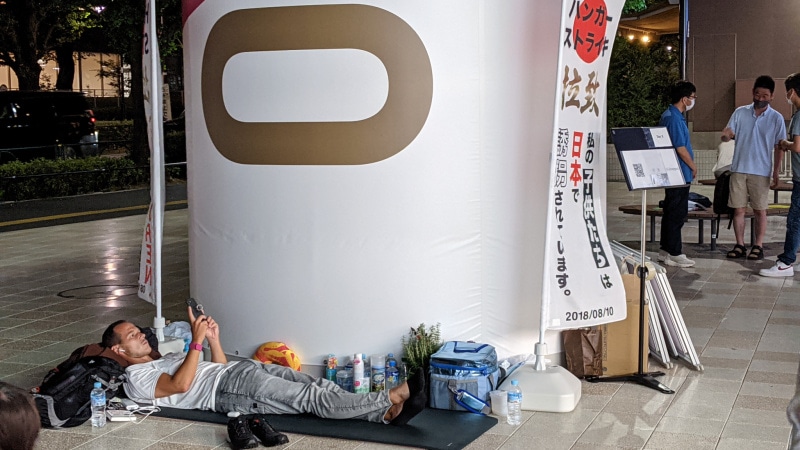
NW Indiana man trapped in Japan, accused of sexual assault, fighting to clear name
Japan’s criminal justice system is often described abroad through one eye-catching statistic: its exceptionally high conviction rate. To some, that suggests efficiency. To others, it raises a harder question—what kind of process produces that level of certainty so consistently?
The Christopher Payne case brought that question into sharp focus. Payne, an American in Japan, was convicted in a sexual assault case that reportedly depended heavily on trace DNA evidence. Later, independent experts raised serious concerns about the scientific reliability of that evidence and how it had been interpreted. In December 2024, the Tokyo High Court overturned the conviction and ordered a retrial after recognizing problems with the DNA testing.
What made the case especially troubling to international observers was not just the disputed evidence. It was the fact that Payne reportedly remained incarcerated even after the guilty verdict was overturned. That detail pushed attention beyond one criminal case and toward a larger concern that human-rights groups have raised for years: the coercive potential of Japan’s detention system.

Infographic: key developments in the Christopher Payne case.
Why the Case Resonated Outside Japan
For many readers outside Japan, the Payne case was unsettling because it challenged familiar assumptions about what should happen when serious doubt emerges in a criminal case. In many legal systems, a conviction being overturned because of suspect forensic evidence would immediately trigger questions about release and procedural safeguards. In Japan, the case instead drew renewed scrutiny to the reality of prolonged detention, solitary confinement, and the difficulty of obtaining bail.
That is why the case became bigger than one defendant. It seemed to illustrate a structural problem: once someone enters Japan’s criminal justice system, detention itself can become a source of pressure.

Editorial image: the human cost of prolonged detention.
What “Hostage Justice” Means
Human Rights Watch has described Japan’s system as a form of “hostage justice.” The phrase refers to the use of detention, isolation, and denial of bail as leverage to obtain confessions. Critics argue that suspects may be held for long periods, questioned without a lawyer present, and placed under intense psychological pressure while prosecutors continue building their case.
This criticism matters because confession occupies a different place in Japan than it does in many Western legal cultures. In English-speaking democracies, the right to remain silent is widely understood as a protection against state overreach. In Japan, critics say confession has often been treated not only as evidence, but also as a sign of remorse and cooperation. That difference can create a dangerous mismatch for foreign suspects, who may assume that firmly maintaining innocence is the safest legal posture.
The Role of Daiyo Kangoku
Another issue is Japan’s daiyo kangoku system, often translated as “substitute prison.” Under this arrangement, suspects can be held in police detention cells rather than independent remand centers before indictment. Amnesty International has criticized this framework for decades, arguing that it increases the risk of coercive interrogation, limits access to lawyers and doctors, and makes abuse harder to detect.
To outsiders, this can be one of the most surprising features of the Japanese system. In many countries, the separation between police investigation and detention management is seen as a basic safeguard. In Japan, critics argue, that separation is much weaker, allowing the conditions of confinement to become part of the investigative pressure itself.

Infographic: how Japan’s “hostage justice” system is criticized.
Why the DNA Issue Matters So Much
The Payne case also highlights a second problem: the danger of overconfidence in forensic evidence. DNA has enormous authority in the public imagination. It sounds scientific, neutral, and nearly infallible. But forensic evidence is only as reliable as the chain of collection, storage, analysis, and interpretation behind it.
According to reporting by the Foreign Correspondents’ Club of Japan, independent experts questioned the prosecution’s methodology and the handling of the underlying data in Payne’s case. Those concerns ultimately became serious enough for the Tokyo High Court to overturn the conviction. Whatever the final outcome of the retrial, the case is a reminder that technical error in a forensic system can carry devastating consequences once it is combined with a detention-heavy justice process.
Why Foreigners Need to Understand the Culture Gap
The deeper lesson is that legal risk in Japan cannot be understood through statutes alone. It also has to be understood through institutional culture. The rules on paper may not fully capture how confession is valued, how detention is used, or how difficult it can be to resist pressure once a suspect is in custody.
That is where the “legal Galápagos” metaphor becomes useful. The term does not simply mean that Japan is different. It suggests a system that has evolved in relative isolation—coherent on its own terms, but increasingly difficult to reconcile with international expectations of due process and human rights.
For foreign residents, businesses, investigators, and families, that distinction matters. A system that feels predictable to insiders may feel bewildering to outsiders, especially in a crisis.

Infographic: the gap between global due-process expectations and criticized features in Japan.
Conclusion
The Christopher Payne case has become a stark illustration of how Japan’s legal system can diverge from global expectations in ways that are not just theoretical, but deeply personal. Disputed DNA evidence, prolonged detention, and the continuing criticism of “hostage justice” all point to the same conclusion: understanding Japan’s legal system requires more than reading the law. It requires understanding how the system actually operates in practice.
For anyone living or working in Japan, that awareness is not optional. It is part of basic risk management.
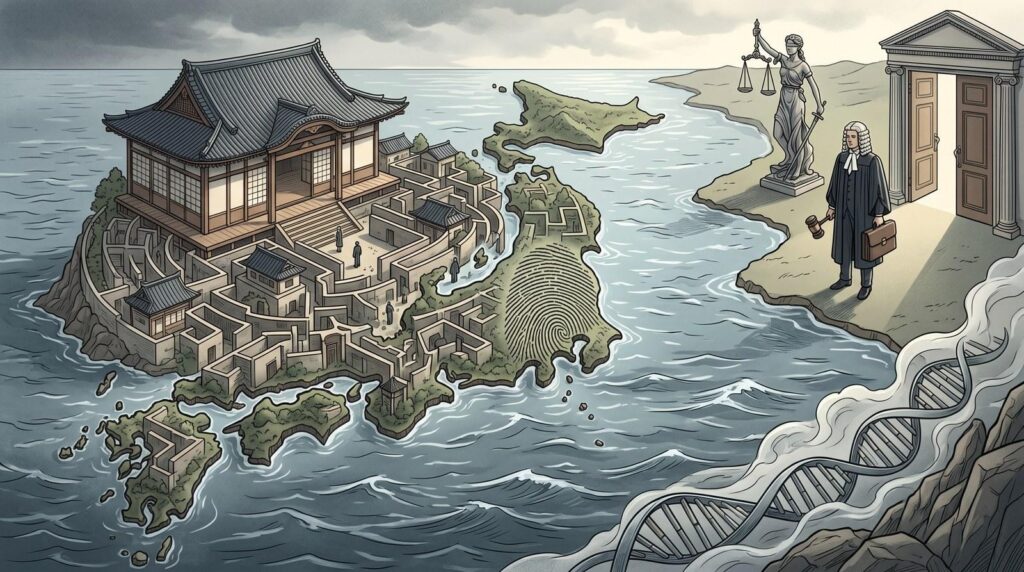
Editorial image: a visual metaphor for Japan’s legal “Galápagos” effect.
Sources
• The Foreign Correspondents’ Club of Japan — Miscarriage of Justice
https://www.fccj.or.jp/number-1-shimbun-article/miscarriage-justice
• Human Rights Watch — Japan’s “Hostage Justice” System
https://www.hrw.org/report/2023/05/26/japans-hostage-justice-system/denial-of-bail-coerced-confessions-and-lack-of
• Amnesty International — The “substitute prison” system: a source of human rights violations
https://www.amnesty.org/en/documents/asa22/010/1993/en/

Infographic: the gap between global due-process expectations and criticized features in Japan.
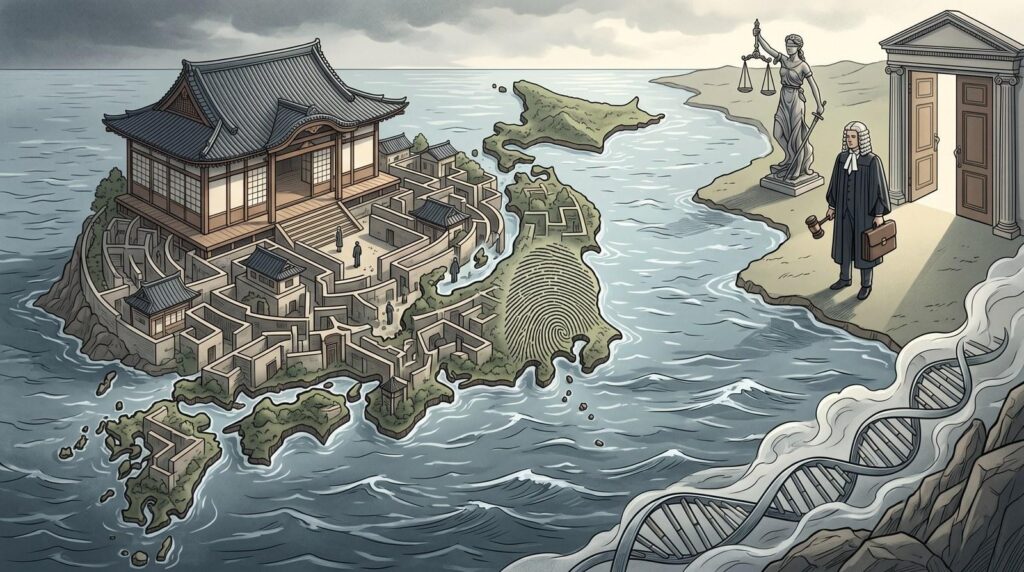
Editorial image: a visual metaphor for Japan’s legal “Galápagos” effect.