
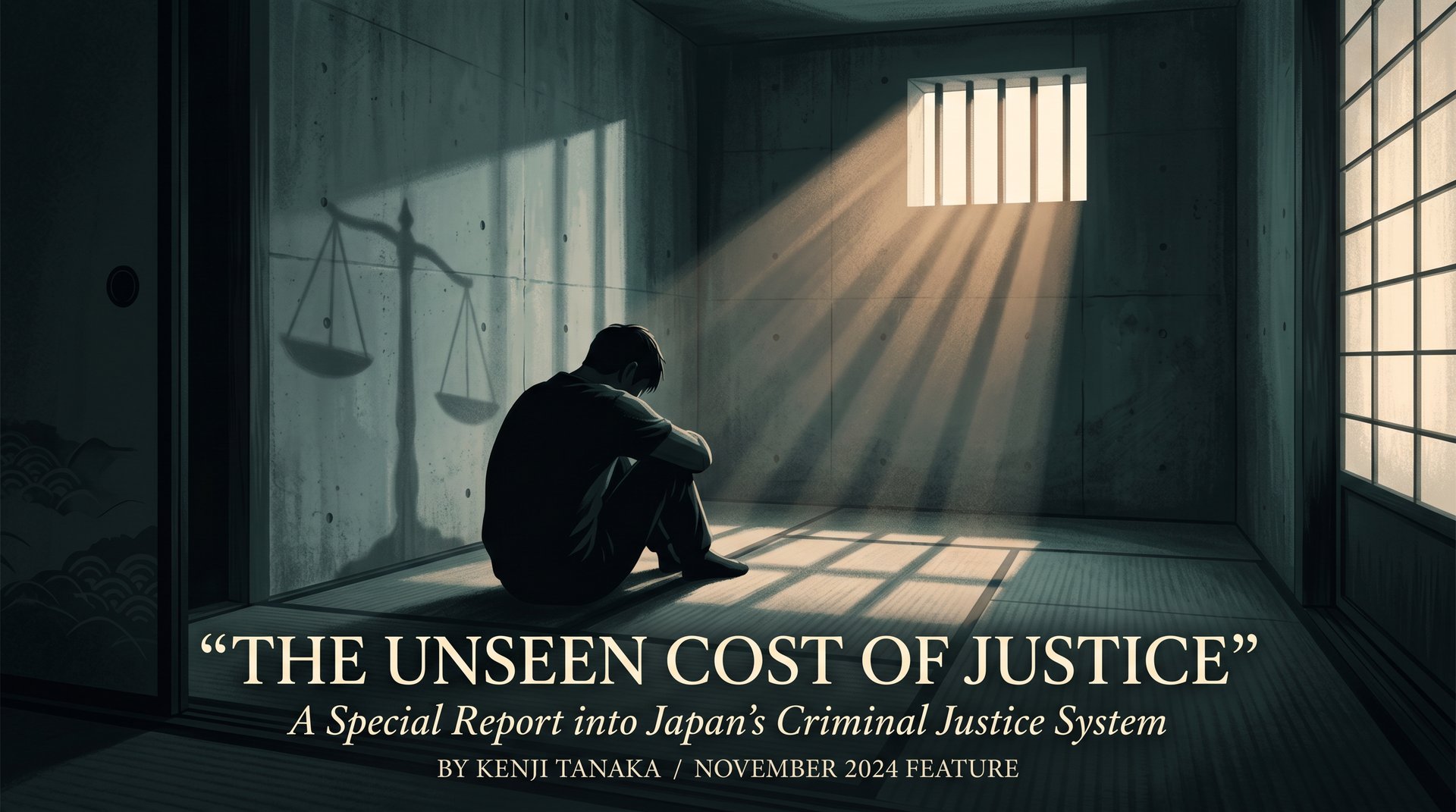
In a recent case that has attracted considerable international attention, an American man was reportedly arrested in connection with a sexual assault investigation in Japan after forensic analysis indicated a match between his DNA sample and evidence linked to the suspect. According to publicly available reports, he has remained in custody for an extended period despite consistently maintaining his innocence. The case has been the subject of commentary in American media, prompting renewed discussion of what international human-rights organizations have long described as Japan’s “hostage justice” practices. More broadly, Japan’s legal system is often characterized—particularly by foreign observers—as “Galápagos-like,” a metaphor for a system that has evolved along its own distinct path and that can appear difficult to reconcile with prevailing international standards of due process. As an international private investigation firm based in Japan, we frequently encounter the very cultural and procedural gap that this case highlights, and we believe a measured, fact-based examination of the issues involved is both timely and warranted.
Japan’s Criminal Justice System: A System Under International Scrutiny
Japan’s criminal justice system is frequently characterized abroad by a single arresting statistic: its remarkably high conviction rate. To some, that figure reflects institutional efficiency. To others, it raises a more uncomfortable question—what kind of process produces such unwavering certainty, case after case?
The international critique tends to converge on a small cluster of features. Human Rights Watch has long described aspects of the Japanese system as “hostage justice”—a phrase capturing the use of prolonged detention, isolation, and the denial of bail as instruments of leverage to obtain confessions. Amnesty International has, for decades, voiced parallel concerns about daiyo kangoku, the so-called “substitute prison” framework under which suspects may be held in police detention cells, rather than independent remand facilities, prior to indictment. Layered onto this is a third concern: the unusual evidentiary weight that confessions and forensic results, including DNA evidence, are perceived to carry once they enter the process.
The Christopher Payne case has not introduced these issues; it has merely brought them once again into sharp relief. What unsettles many international observers is less any single feature than the way these features compound—how detention, interrogation, and forensic deference can interlock to produce outcomes that look procedurally orderly from within Japan, yet appear deeply alien from the outside.
That is the shape of the cultural and legal gap between Japan and the West. The rest of this article is about what it actually feels like to work inside it.
Inside Japan PI: A Foreign-Facing Private Investigator’s View from Tokyo
From our vantage point as an international private investigation firm operating inside Japan, the issues outlined above are not abstractions. They are the daily texture of the work we do—for foreign families, multinational corporations, defense counsel, immigration applicants, and individuals navigating Japanese institutions for the first time. What follows is an honest portrait of that work, including its less comfortable contours.
1. Why Private Investigation Is Undervalued in Japan and the Far East
This is a point that surprises many of our overseas clients. In the United States, the United Kingdom, and much of Europe, the private investigator occupies a recognized—if sometimes romanticized—place in the legal and corporate ecosystem, working alongside attorneys, insurers, and compliance teams. In Japan and across much of the Far East, the profession enjoys no such standing. It is not deeply embedded in legal practice, not actively cultivated by regulators, and not generally regarded by law enforcement as a legitimate parallel function. The result is a working environment in which investigators operate without the institutional respect their counterparts in the West largely take for granted.
2. Legal Risks for Private Investigators Operating in Japan
Because private investigation is not strongly valued by Japanese police or prosecutors, investigators here face a heightened risk profile. Activities that, in other jurisdictions, would be unambiguously lawful or fall comfortably within professional norms can, in Japan, attract suspicion or accusations of improper data access. A misstep—or even an action that is later interpreted unfavorably—can expose an investigator to arrest. Combined with the same hostage-justice dynamics that concern foreign defendants, this means that Japanese PIs themselves live with an awareness that prolonged detention is not a remote, theoretical risk. It is a structural feature of the environment we operate in.
3. FBI and RCMP Fingerprinting: A Routine Service With Real Consequences
A meaningful share of our daily activity is administrative and procedural rather than dramatic. To take one example, we currently process FBI and RCMP fingerprinting for roughly five individuals each week—primarily for visa, licensing, and immigration purposes. These are not criminal investigations. The fingerprints are forwarded to the FBI or RCMP databases, where they may later be referenced in criminal inquiries in the United States or Canada. Cases such as the Payne matter are a sobering reminder of how much weight forensic identification can carry downstream, and of how seriously even routine fingerprinting must be performed. A single unclear print, mishandled at the collection stage, can ripple outward in ways the subject would never anticipate.
4. The Distinctly Japanese Social Issues That Drive Our Caseload
Many of the matters that come to us are rooted in tensions distinctive to Japanese society:
- The use of hostage justice by law enforcement and prosecutors creates a difficult position for foreign defendants and their families.
- A demanding, seniority-based work culture that quietly drives a substantial volume of personal crisis cases.
- Adults who have deliberately disappeared—a recurring social phenomenon in Japan, with its own well-developed vocabulary and patterns.
- Parental child abduction, an issue that has long strained relations between Japan and several Hague Convention partners.
- An outdated citizen documentation infrastructure, including the koseki family registry, can be ill-suited to the realities of international families, dual nationals, and modern privacy expectations.
- Cross-border debt recovery, where Japanese procedural norms diverge sharply from those Western creditors are accustomed to.
Each of these is, in its own way, a manifestation of the same underlying gap: a society whose institutional reflexes evolved largely on their own terms, and which now contends with cases that will not neatly stay within those terms.
5. The Legal Gray Zone: An Honest Acknowledgment
We think it is important to speak plainly about this. Private investigation in Japan can sometimes resemble a form of vigilante work—not in the sensational sense, but in the structural sense. Because the profession is neither tightly regulated nor culturally embraced, we often navigate gray areas to obtain information that clients legitimately need but cannot reach through ordinary channels. We do this carefully and deliberately, within our internal standards of conduct, but we do not pretend the gray area does not exist. The hostage-justice environment is, for us, a constant background concern. We have accepted that reality, and we work responsibly within it because the social and legal problems we are asked to help address are real, and because the alternative—leaving foreign clients without a competent advocate inside the system—is, in our view, worse.
6. Cultural Translation: The True Core of an International PI Firm
Surveillance, document retrieval, and fingerprinting are tools. The deeper service we provide is translation—rendering Japanese institutional logic intelligible to Western clients, and rendering Western expectations intelligible to Japanese counterparts. The “legal Galápagos” metaphor is useful here precisely because it captures what isolation produces: not deficiency, but distinct evolution. Working effectively across that gap requires more than language fluency; it requires institutional fluency on both sides, and a steady tolerance for ambiguity.
Conclusion: Bridging the Japan–West Legal Divide, One Case at a Time
The Christopher Payne case has reminded the international community that Japan’s legal system can diverge from global expectations in ways that are not merely theoretical, but profoundly personal. For those of us who work at the seam between Japan and the wider world, the case is also something more familiar: another reminder that understanding Japan requires moving beyond the statute book and into the lived practice of its institutions—and, sometimes, into the gray spaces between them.
That is the terrain on which Japan PI works. We do so with full awareness of the risks, with honest respect for Japanese institutions even where we find them difficult, and with a clear sense of duty to the foreign clients who, more than ever, need a competent counterpart inside the system.
Sources
- The Foreign Correspondents’ Club of Japan — Miscarriage of Justice
https://www.fccj.or.jp/number-1-shimbun-article/miscarriage-justice - Human Rights Watch — Japan’s “Hostage Justice” System
https://www.hrw.org/report/2023/05/26/japans-hostage-justice-system/denial-of-bail-coerced-confessions-and-lack-of
Amnesty International — The “Substitute Prison” System: A Source of Human Rights Violations
https://www.amnesty.org/en/docume