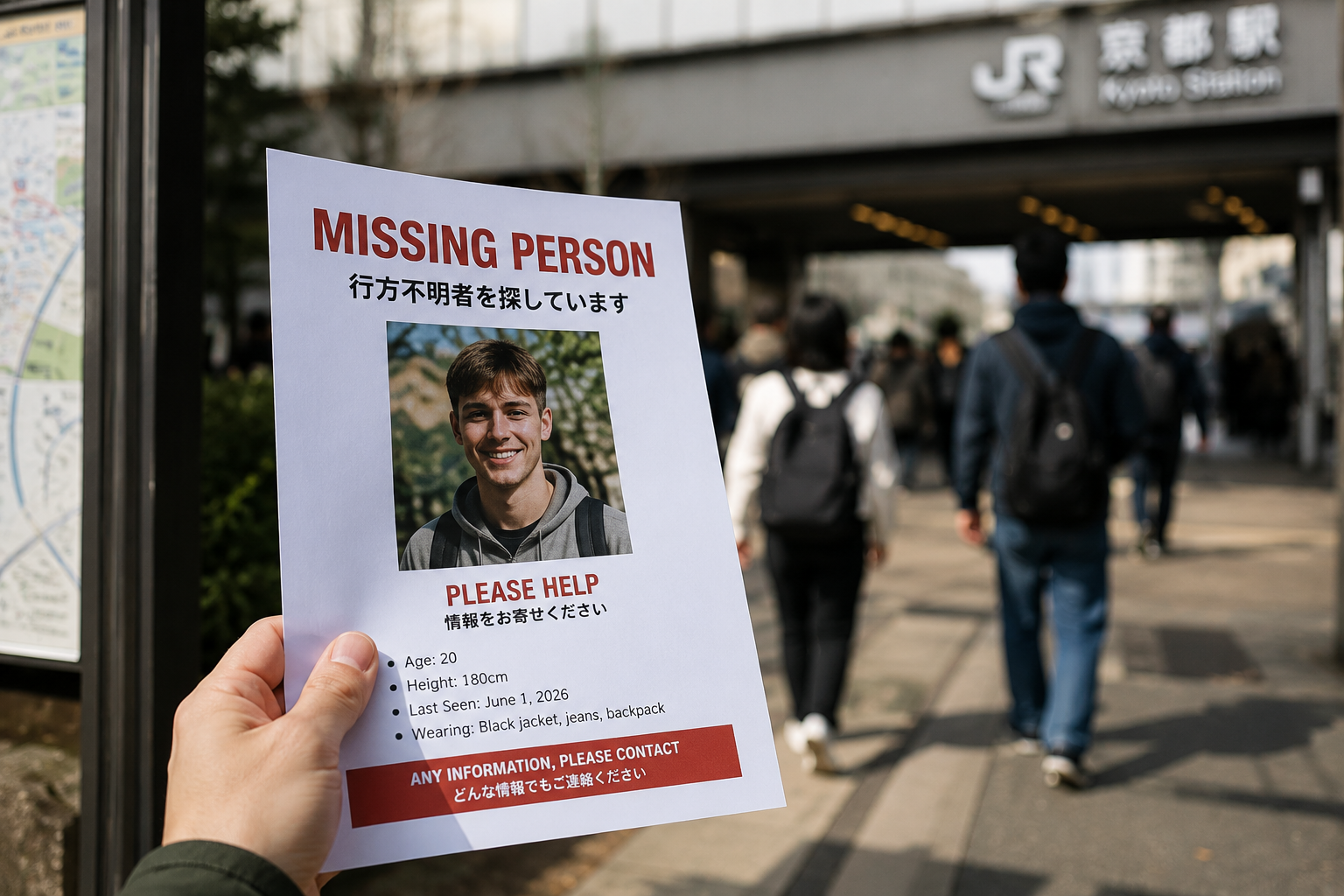
On June 7, 2026, searchers found the body of a 20-year-old American man in Japan on a family trip in the mountains outside Kyoto.
Reference:
Missing Auburn University student in Japan found dead, mother says: “Unimaginable loss” – CBS News
https://share.google/kNAEHxgi2MI9Dd3pp
Families overseas sometimes come to us in situations like this: a relative who has vanished somewhere in Japan. But when someone disappears suddenly, and the clock is running, the truth is that a private investigation firm can do startlingly little in those first critical hours. Every time, we feel the gap between how badly we want to help and how little the law actually lets us do.
A family on the other side of the world was a son or daughter who had gone silent in Japan. A phone was switched off. The mounting certainty that something has gone badly wrong. And almost no time left to act. That is the situation waiting on the other end of nearly all of these calls and contact forms.
These are the cases in which the distance between what families expect of us and what Japanese law permits is widest. Families deserve a candid account of where that distance lies — and of the real, constructive role a Japanese investigation firm can still play for a family in crisis. That is what we want to offer here.
The Expectation Gap
When a family first contacts us about an urgent disappearance, they almost always picture the same set of capabilities. Movies, television, and the very different investigative landscape of their homeland shaped that picture. Specifically, they expect us to:
- Pull security-camera footage from roads, stations, trains, and shops
- Obtain a cell phone’s location history from the carrier
- Read transit IC-card (Suica, ICOCheckASMO) records to see which stations someone passed through
- Check credit-card statements to follow purchases in real time
Any one of these would shrink the search area from “somewhere in Japan” to a single rail line, a single city, sometimes a single neighborhood. That is exactly why families ask for them. In Japan, though, every one of them sits well beyond a private firm’s reach.
Why We Can’t Reach That Data
This has nothing to do with our skill, our contacts, or any reluctance to work hard. It is structural. So that no one mistakes our answer for a lack of will, let us explain it plainly.
Understanding Japanese law under the Detective Business Act is helpful, as it clarifies what that law does and does not do. It requires us to file a notification with our prefecture’s Public Safety Commission, it regulates how we conduct our work, and it protects consumers from abuse within the industry. It grants usial datastigative authority and no privileged access to data of any kind.
The information families ask for sits behind several walls of legal protection:
The secrecy of communications. The Constitution protects the secrecy of communications, and the Telecommunications Business Act reinforces it. A carrier cannot hand over location or call records to a private citizen. Even investigators with a badge must follow proper legal procedure to obtain them.
The Act on the Protection of Personal Information (APPI). Railways, retailers, banks, and camera operators treat their records as personal data and cannot release any of it to an outside party without a lawful basis. A private inquiry from an investigation firm does not qualify.
Private control of footage. The security-camera footage from roads, stations, trains, and shops belongs to the operators who run those systems. They release it to the police conducting the investigation—not to us.
A larger picture sits behind all of this. In Japan — and, in our experience, across several jurisdictions in East Asia — the state has consistently hesitated to hand genuine investigative authority to the private sector. The system rests on one assumption: that the police, accessors, and government agencies should have the power to access communications, financial, and surveillance records. That single assumption explains why the private-investigation profession here lacks the standing and access that licensed investigators take for granted across much of North America and Europe. It is the heaviest structural constraint our profession carries, and we feel it most sharply in exactly these emergencies.
So when we tell an anxious parent that we cannot track a phone or pull camera footage, we are not lowering expectations. We are describing a wall that runs the full height of the legal system.
In an urgent disappearance that may involve suicide, an accident, or a crime, the police can do what we cannot: review camera footage, pinpoint where someone was last seen, and narrow the search. This part of the work belongs to the investigating authorities, and a private firm cannot stand in for them — we have to leave it in their hands.
Once that initial police work narrows the search area, though, the next phase turns analog. It comes down to people covering ground on foot. That is where we step in. We can recruit searchers, brief them, divide the terrain into sectors, prepare bilingual flyers, and serve as the on-the-ground link between an overseas family and the Japanese-speaking volunteers walking the hills.
A social-media app, leading well-crafted apps to Japanese and English surfaces, leads a family abroad that could never gather on its own. We run the Japanese side, then sort and verify the tips that come in.
Fundraising. Families have used platforms like Goon-the-ground worksional seawith rch teams and cover the costs of working on the ground.
Working thuntriesfol, lows a famifollows ly moves the press at home, Japanese outlets often follow. Steady, measured media attention can also push the official investigation to treat a case with the urgency it deserves.
What these stages call for is coordination, language, local knowledge, and a real presence on the ground. That is what we can offer the family of someone who has suddenly gone missing.
The Hard Reality
As all of this shows, a Japanese investigation firm can do only so much in an emergency search, and we can only be honest about that. We have no interest in selling a feel-good service that amounts to little more than “better than doing nothing.”
That said, where we can genuinely help, it is here: appeals through social media, outreach to the news media, and a bridge between the family and the state of the police investigation. And once the investigation narrows the search to a workable area, we can dispatch investigators and put out the call to organize a volunteer search party. That kind of support sits well within our reach.
Showing a family how to move the media, how to rally local volunteers, and how to steer their own efforts — that consulting role is one we gladly take on.
If your family faces an urgent disappearance in Japan, the first step is always to file a missing-person report with the local police. If you can, bring a lawyer with you, so the case gets the seriousness it deserves. Because a Japanese investigation firm cannot run the initial work of narrowing down where an emergency missing person has gone, the single most important thing you can do is make the police understand, in precise terms, that this is an emergency disappearance — and press them to begin their initial investigation as early as possible.