Japan’s corporate credit information market is dominated almost exclusively by two firms — Teikoku Databank (帝国データバンク, TDB) and Tokyo Shoko Research (東京商工リサーチ, TSR) — a structure that stands out as remarkably unusual on the global stage. For due diligence professionals approaching this market from overseas, simply thinking of them as “Japan’s version of D&B” falls significantly short. The following examines five dimensions that make this market uniquely Japanese.
1. Origins and Market Monopoly
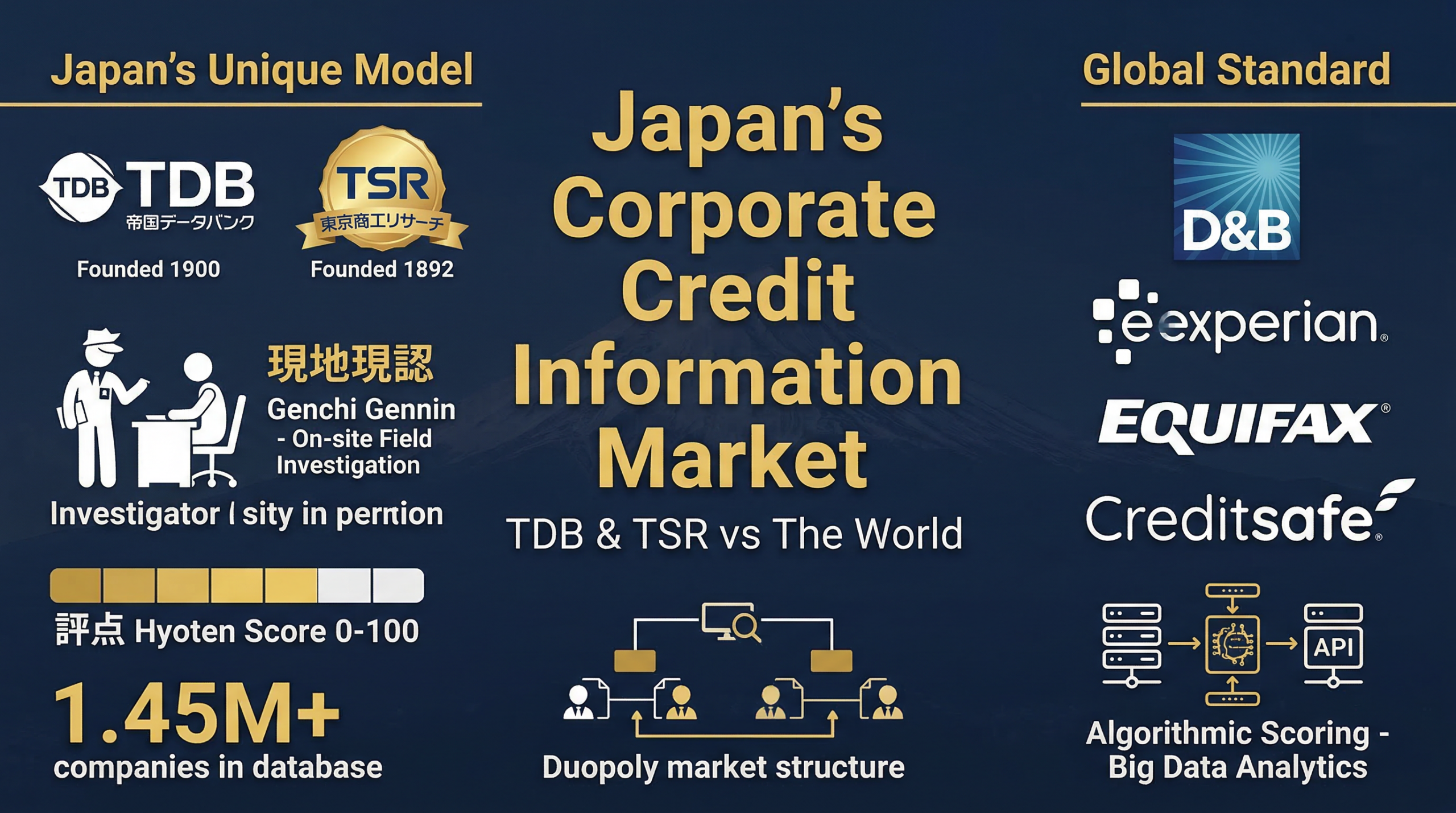
TDB was founded in 1900, and TSR in 1892; both have over a century of history. These two firms continue to effectively divide the domestic corporate credit research market between them. TDB’s database, COSMOS2, contains information on over 1.45 million companies nationwide.
By contrast, Western markets operate in a competitive, multi-player environment. In the United States, the United Kingdom, and Australia, firms such as Dun & Bradstreet, Experian, Equifax, TransUnion, and Creditsafe compete intensely, differentiating themselves through scoring methodologies and pricing. Creditsafe currently covers over 430 million business reports across more than 200 countries. The reason foreign players have found it difficult to enter the Japanese market lies in the very mechanics of information gathering described below — a system that, in its own right, functions as a structural barrier to entry.
Reference URLs
TSR Global Services: https://www.tsr-net.co.jp/global/ / TDB COSMOS2: https://www.g-search.or.jp/contents/yoshin/rxcc.html / Creditsafe vs D&B Comparison: https://www.creditsafe.com/gb/en/more/hub/compare/creditsafe-vs-dun-and-bradstreet.html / Credit Scoring Around the World: https://www.chase.com/personal/credit-cards/education/credit-score/do-other-countries-have-credit-scores
2. The “Genchi Gennin” (現地現認) Philosophy: A Fieldwork-First Approach
The area where TDB and TSR diverge most sharply from international norms is their methodology for collecting information. TDB explicitly states in its service descriptions that its guiding principle — upheld for over a century — is “genchi gennin” (現地現認), meaning on-site, firsthand verification. The firm maintains 83 offices across all 47 prefectures and has dedicated field investigators who visit companies in person and conduct face-to-face interviews with senior management.
TSR takes a similar approach, with assigned investigators gathering information through direct visits and personal interviews. According to a LinkedIn post by an industry veteran, when conducting credit research, investigators typically visit the company — often the president directly — and encourage the disclosure of financial statements.
By comparison, Western firms such as D&B, Experian, and Creditsafe aggregate public registry data, tax records, payment histories, and alternative data through web crawling and API integrations, generating scores algorithmically. The concept of a field investigator visiting a company president in person simply does not exist within the global standard. The Japanese model is fundamentally rooted in human networks and ground-level judgment — a philosophical departure from the IT-driven quantitative models that predominate internationally.
Reference URLs
TDB Credit Research Business Overview: https://www.tdb.co.jp/about/business/sinyou/ / TDB: For Those Who Have Received a Visit Notice: https://www.tdb.co.jp/about/business/sinyou/interview/ / Understanding International Credit Reports: https://www.businessinsider.com/personal-finance/credit-score/how-to-transfer-international-credit-score-to-us
3. The Hyoten (評点) System: Institutionalized Opacity in Qualitative Assessment
At the core of TDB and TSR’s rating output is a proprietary score known as the hyoten (評点). Expressed on a scale of 0 to 100, it represents a company’s creditworthiness based on a composite of both quantitative and qualitative factors, including years in business, capital, financial condition, management quality, and social standing.
As a practical benchmark, a score of 50 or above is considered “no concerns,” 60 or above indicates a solid company, and 70 or above is reserved for companies of exceptional standing on a par with listed firms. Companies scoring below 50 are assigned a symbol rather than a number (TDB uses D1–D4; TSR uses W–Z). Banks regularly cite these scores when approving loans — in many cases, loan officers use them as a shield against personal accountability, effectively functioning as de facto market infrastructure.
International corporate credit scoring systems — such as D&B’s DUNS rating or Experian’s Intelliscore — process verifiable quantitative data (payment history, bankruptcy probability, etc.) algorithmically, with an emphasis on methodological transparency. Japan’s hyoten, by contrast, incorporates the subjective judgment of the field investigator in a way that cannot be separated from the score. The concepts of reproducibility and independent external audit of the scoring rationale are largely absent, which sets it apart from global rating norms.
It is worth noting that at both TDB and TSR, the investigators responsible for credit research also carry a sales function. This means the hyoten reflects not only objective financial data but also subjective qualitative impressions of the executive — their openness to disclosure, their cooperative attitude in interviews, and their ongoing relationship with the investigator. Companies that purchase premium services or maintain close ties with their assigned investigator may benefit from an unconscious, favorable “adjustment” in their score. For this reason, the hyoten should not be treated as an absolute measure in credit decision-making, but rather as one reference data point to be used alongside other information and independent verification.
Reference URLs
TDB & TSR Hyoten Explained (Former Banker): https://human-trust.co.jp/ht-finance/column/tips/tsr/
Comparing TDB and TSR Scores: https://zaimuichiro.xsrv.jp/ppc/tdb%E3%81%A8tsr%E3%81%AE%E8%A9%95%E7%82%B9-1930.html
TSR Domestic Company Research: Overall Evaluation: https://www.tsr-net.co.jp/service/national/evaluation/
4. The Absence of Financial Disclosure Obligations for Unlisted Companies and Structural Limitations on Information Access
The reason TDB and TSR continue to operate a human-centered investigative model lies in a structural problem embedded in Japan’s legal framework. Under Japan’s Companies Act (会社法), privately held small and medium-sized enterprises — approximately 2.6 million companies — are not subject to any meaningful obligation to publicly disclose their financial statements. Most SMEs submit only the minimum documentation required for tax filing purposes.
4-1. Non-Disclosure of UBO (Ultimate Beneficial Owner) Information
In Japan, there are no publicly accessible records from which Ultimate Beneficial Owner (UBO) information can be readily obtained. This is not merely a matter of convention — it is a systemic gap.
Japan’s corporate registry extracts (toukibo touhon, 登記簿謄本), issued by the Ministry of Justice (法務省), do not include shareholder information. In January 2022, a new “Beneficial Ownership List System” (Jissshiteki Shihaisha Risuto Seido, 実質的支配者リスト制度) was introduced. Under this system, corporations (including general incorporated associations and foundations) may voluntarily register their UBO information with the Legal Affairs Bureau (法務局), receive official certification, and present that documentation to financial institutions and other parties. As the documentation is certified by a registry official, it carries a degree of formal credibility. However, this system has fundamental limitations from a due diligence perspective.
First, the information is not made available to the general public. The system is designed solely to help the subject corporation provide certified documentation to financial institutions during onboarding and transaction procedures. Third parties — external investors, business partners, or investigation firms — cannot query the Legal Affairs Bureau to obtain UBO documentation for any given company.
Second, by its very nature, the content of this system is based on the corporation’s self-reporting. What the registry official certifies is the form of the submission, not an independent verification of the accuracy of the disclosed beneficial ownership. In practice, when a subject company provides this documentation during due diligence, it is standard procedure to cross-reference it with supporting materials such as a shareholder register and articles of incorporation.
In short, this system cannot serve as a resource that a third party can actively and independently access for due diligence purposes. It serves only as supplementary documentation when the subject company voluntarily discloses it.
4-2. The Reality of Financial Statement Disclosure Obligations — A Nominal Rule with Toothless Enforcement
The financial disclosure regime is similarly hollow in practice. Japan’s corporate registry includes a field for “method of public notice” (koukou no houhou, 公告の方法), which requires companies to specify how they will publish required announcements — typically through the Official Gazette (kanpou, 官報), major newspapers such as the Nikkei (日本経済新聞), or their own website.
The legal basis for this requirement is Article 939 of the Companies Act (会社法第939条), which provides that the default method of public notice is the Official Gazette when a company has not otherwise specified in its articles of incorporation. Violations — including failure to publish financial statements — are subject to fines of up to 1 million yen under Article 976 of the same Act.
In practice, however, enforcement of this provision has been extremely lax. While it would be inaccurate to say that fines are never imposed — there are rare documented cases — violations have historically been overlooked as a matter of course. The result is that a vast number of Japanese companies operate without ever publishing their financial statements, and this provision can only be described as lacking meaningful practical enforcement.
In an environment where financial disclosure cannot be legally compelled, TDB and TSR’s model of having investigators personally visit company executives can be understood as a rational alternative mechanism for information gathering.
4-3. Recent Legislative Changes Further Eroding the Due Diligence Environment
Recent legislative amendments have made business due diligence in Japan increasingly difficult — a trend that, from the perspective of international compliance practice, represents a clear regression.
1) Representative Director Address Concealment Measure (Daihyo Torishimariyaku-to Jusho Hihyoji Sochi, 代表取締役等住所非表示措置) — Effective October 1, 2024
Effective October 1, 2024, a new measure allows representative directors of stock companies to apply to have the detailed portion of their address — beyond the city, ward (in Tokyo’s 23 special wards), or designated city district — suppressed from the publicly accessible corporate registry. This significantly limits the address information available through public records for investigations aimed at verifying a representative’s location or identifying individuals.
2) Restriction on Name Searches in the Electronic Official Gazette (Denshi Kanpou, 電子官報) — Effective April 1, 2025
Under a legislative amendment to the Act on the Publication of the Official Gazette (Kanpou no Hakkou ni Kansuru Houritsu, 官報の発行に関する法律), effective April 1, 2025, it is no longer possible to search the Electronic Official Gazette by an individual’s name for entries relating to bankruptcy proceedings, naturalization, and similar matters. In the interest of strengthening privacy protections, relevant entries have been converted to image format and rendered non-searchable, and the public availability period has been limited to 90 days. This has substantially curtailed the scope of comprehensive due diligence and credit investigation using publicly accessible online tools.
While each of these legislative changes carries some rationale from a personal privacy protection standpoint, from the perspective of third-party business due diligence, they make Japan’s information infrastructure for corporate and individual investigations even more opaque and widen the gap with international compliance standards.
Reference URLs
Beneficial Ownership List System (Legal Affairs Bureau / 法務局): https://houmukyoku.moj.go.jp/homu/page7_000016.html / Reading Japanese SME Financial Statements: https://onestepbeyond.co.jp/blog/financial-health-check-interpreting-japanese-sme-balance-sheets/ / Representative Director Address Concealment Measure (Ministry of Justice / 法務省): https://www.moj.go.jp/MINJI/minji06_00166.html
5. Attempts at Global Integration and Their Limitations
TSR has maintained an alliance with Dun & Bradstreet since 2005, which has strengthened into a strategic partnership in 2012, and serves as the sole distributor of D&B products in Japan. TDB also operates an English-language service providing international corporate credit research reports for overseas entities.
That said, credit reports on Japanese domestic companies remain predominantly in Japanese and include qualitative “personal profile” components — such as a 25-item section describing the executive’s personality, network, and management style — that are inherently difficult to translate or standardize. The transition toward the quantitative, algorithmic scoring typical of global standards has been limited. This business model stands in sharp contrast to emerging players who leverage web crawling and Japan’s Corporate Number system (houjin bangou, 法人番号) — administered by the National Tax Agency (Kokuzeicho, 国税庁) — to construct databases of more than five million companies in a single day.
Reference URLs
TSR Dun Report (D&B Report): https://www.tsr-net.co.jp/service/detail/dun-report.html / TDB English Corporate Credit Research: https://www.tdb-en.jp/services/ccr.html / Comparison with TDB and TSR: http://tokyosrc.com/archives/qa/teikoku-date-bank
Conclusion: Practical Takeaways for International Due Diligence Professionals
For due diligence professionals approaching Japan from overseas, the essential points to keep in mind are:
- TDB and TSR reports are not database outputs — they are qualitative “investigative reports” compiled by field investigators. The scoring involves human judgment, and the rationale for the calculation is opaque.
- The hyoten is shaped by the cooperative relationship between the company and the investigator, not by legally mandated financial disclosure. Companies that maintain a positive relationship with their investigator and proactively share information tend to receive higher scores.
- Financial statements of unlisted companies are generally not publicly available. TDB and TSR reports may represent the only obtainable third-party information. Although the Companies Act (Article 939) imposes an obligation to publish financial statements, enforcement through fines is extremely rare in practice, rendering the obligation effectively toothless.
- Beneficial ownership information exists as a system but is not disclosed to parties other than financial institutions. Corporate registries do not include shareholder information, and the Beneficial Ownership List System is not designed for third-party access. Due diligence requires voluntary disclosure by the subject company, cross-referenced against supporting materials such as shareholder registers and articles of incorporation.
- Global D&B and Creditsafe coverage of Japan relies heavily on data provided by TDB, making it genuinely difficult to cross-reference multiple truly independent sources.
- Recent legislative changes — the representative director address concealment measure and restrictions on Electronic Official Gazette searches — have further curtailed the investigative environment. International due diligence professionals need to be increasingly aware of the limitations of public-record-only investigations.
It is inaccurate to think of Japan’s corporate credit information infrastructure as simply “the Japanese version of a Western credit bureau.” It is, rather, a proprietary information infrastructure born of over a century of accumulated human networks and fieldwork-based intelligence, developed in a market where legal disclosure obligations are thin. It deeply reflects the characteristics of Japanese business culture — the primacy of personal relationships, structural information asymmetry, and individualized trust between executive and investigator. And its structural opacity is only deepening with recent legislative changes.
Reference URLs
Beneficial Ownership List System (Legal Affairs Bureau / 法務局) https://houmukyoku.moj.go.jp/homu/page7_000016.html / Reading Japanese SME Financial Statements: https://onestepbeyond.co.jp/blog/financial-health-check-interpreting-japanese-sme-balance-sheets/ / Due Diligence for Private Acquisitions in Japan (Ushijima & Partners / 牛島総5f8b事務所): https://www.ushijima-law.gr.jp/fwp/wp-content/uploads/2022/04/Due-Diligence-for-Private-Acquisitions-in-Japan-2.pdf / Comparing TDB and TSR Scores: https://zaimuichiro.xsrv.jp/ppc/tdb%E3%81%A8tsr%E3%81%AE%E8%A9%95%E7%82%B9-1930.html / TSR Domestic Company Research: Overall Evaluation: https://www.tsr-net.co.jp/service/national/evaluation/